
LED LED LED
Singapore, 8th March 2011
There is some LED craze going on in this world… It feels like I keep blogging about it. Originally LED lighting started as a small signalling or indicating light source. But since the breakthrough in technology made it possible to dramatically improve its performance it became a tool for many “real” lighting applications both in architectural as in events lighting. When the creation of “true” white light became possible with LED technology it became even more a must do/ have lighting source in our day to day lighting needs. Certainly with the ever-increasing social consciousness in regards to global warming and the need to reduce carbon emissions and thus the power consumption for lighting.
It looks like we have come full circle now with LED making inroads in applications that really don’t need any lighting but where the LED has become more of a gadget. I Googled LED innovations as part of my research for a project and was amazed with what I found. LED eye lashes, LED mouth guards, LED Bikini’s, LED umbrella’s, LED tattoo’s (!), LED shoes and clothes, LED clothes pegs, LED wine bottles, LED music instruments…and the list goes on and on.
How far do we go with this LED craze? Gadgets can be fun, admitted, but somehow there should be an element of usefulness in innovations? At least that is my thought. There is already so much rubbish in this world that we can certainly do without a lot of it.
The reason I was looking up LED innovations was to see if there are any new clever ideas in applying LED’s to make our daily life more enjoyable, more comfortable, more practical or more special. Often we look at ways to make our project unique and recognisable by introducing a feature lighting element and logically searching for some new and interesting LED applications is one of the options…I just did not expect what I found J
In Light Watch today I somehow want to honour innovation and specifically the speed of LED innovation but I am not sure to what extent… This is just a snapshot grabbed from the net of one area but as I mentioned there is much more…let me know if you have any really innovative (and useful) LED innovation…
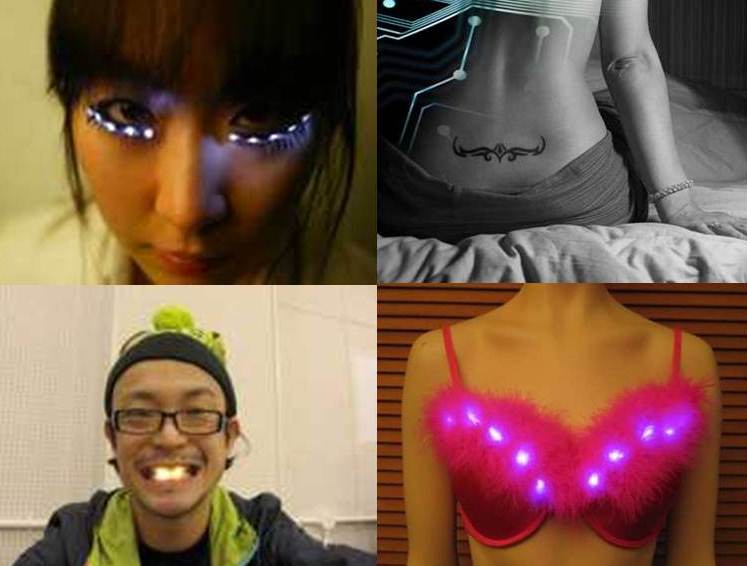
Light Watch 47: LED gadgets
How wild can you go?
Singapore, 7th March 2011
When we start brainstorming and conceptualising a lighting design one of the first things that comes up is how wild (or how conservative) should your design be. Many clients don’t really restrict you but in the end we always know that someone has to pay for it, right? We design with the client’s money so somewhere we need to understand what the brief is and even more what the budget is.
And that is where the challenge lies because putting up a budget right upfront may seriously limit the creative idea development as it may cut out any wild ideas that we know will be expensive. Most of the times clients have a budget but don’t tell us as they want to see what could be done, only to put cold water on your hot ideas later on.
However there is much to say to let the creative juices flow without boundaries or limitations. What seems like crazy ideas may eventually be engineered to something feasible and affordable! The best and simplest of lighting concepts are most of the time arrived at by going through the whole motion of crazy ideas and lots of researching and trying out. The thing with creativity is that you need inspiration (and motivation) which often is derived from initially wild ideas. The more experienced you are the better you are able to “control” and direct the creative part of the design process, but thing with inspiration is that sometimes it flows but sometimes it’s just stuck.
This is one of the core values of KLD, the importance and quality of the creative design process. Though we always have to work along timelines and budgets, creation cannot always be ordered to measure…it is a process in which all parties (client and designer) need to respect each other to get the best possible results. Everyday should have motivation, inspiration and creation, that is what design is about…..
In Light Watch today one of the wild LED concepts in China. A recently completed shopping mall with a huge TV screen hung of the ceiling. It is about 250m long and 30m wide (!) Costing about 32 million dollars it is not your average installation, but it is a huge attraction and from the feedback received worth its extra investment.
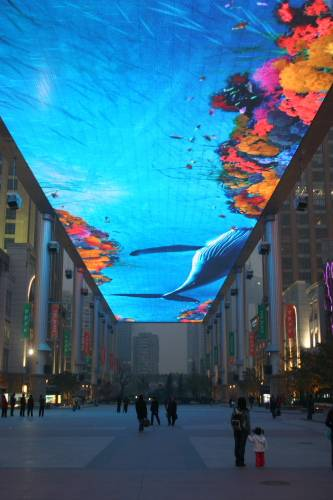
Light Watch 46: LED ceiling, Beijing Mall
Boss or bossy
Singapore, 4rd March 2011
In continuation of responsibilities, the subject of my blog yesterday, I would like to touch on the aspect of being the boss or being just bossy. In Asian culture hierarchy and position in life (and business) plays an important role. In our business we deal with decision makers all the time. Someone has to make decisions during the design, development or installation process and not always everyone assigned to do this, is actually in a position or let alone qualified to do this even though some like to project that they do.
To me it is highly inefficient when you have to deal with someone who pretends to be in charge only to find out that that person is later being overruled by their boss again. Sure you can be representing your boss with a certain mandate but you need at all times to be clear that your decision or instruction is subject to your boss’s approval.
Unfortunately there are always those people that have not much to say in their own office, but once being put in charge of a project outside use their position to be bossy and unreasonable just to show off. These are the worst managers. I am sure some of you can relate to this. I have met heaps of project managers as a lighting designer and the best ones are those who respect your expertise, query you when needed but trust your experience. They manage and they lead. But they don’t bully you around. They respect people time and efforts. In other words they are the boss but they are not necessarily bossy. There is a world of difference between a good leader being the boss and a manager showing (or should I say abusing) his power by being bossy.
Of course all this under the premise that you as the lighting designer deliver and know your stuff…..
In Light Watch today I refer to someone who is known around the world as “the Boss”, Bruce Springsteen. He acquired his knick name early in his career when he looked after his band by collecting money and then distributing it to his mates. A rock concert is definitely a light show worth watching nowadays. Today’s technology allows some incredible effects!
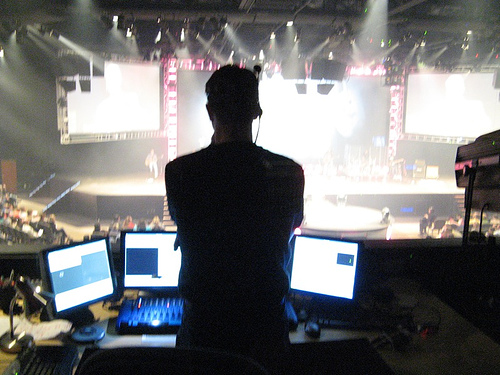
Light Watch 45: Rock concert by “the Boss”.
Responsibility
Singapore, 3rd March 2011
Ducking responsibility often happens when it comes to projects. When we have multidisciplinary consultants involved all working in a team it is important to agree (and know) who is responsible for what! Most of the times however our contracts are made before the designs are actually completed. Yes there is an overall space planning but for many areas, specifically between front and back of house areas, or transition areas from inside to outside or from one building to another the responsibility may not be properly defined. In two of my projects there is another lighting consultant involved for the exteriors while I am responsible for the interiors. Where does each other’s responsibility stop? Who has the final say when there is overlapping responsibility?
Some contracts are limited when it comes to repetitive work. For instance an interior designer may have agreed to design one standard space (say a hotel room) only and leave it to “others’ to figure out the application (and implication) for the rest of the spaces. But if our contract stipulates that we are responsible for all spaces there is a lack of information to figure out the rest of the lighting required?
There are many of those contractually not matching responsibilities which leave grey areas that often only appear half way the project. We then have to decide whether we take these grey areas in our stride and add them to our scope of responsibilities as a measure of goodwill or we adapt a stubborn attitude more or less along the lines of “pay me if you want me to do this”. Obviously the latter will not make you many friends and may even rule you out for any further work in the future however professionally there is nothing wrong if you have clearly defined your scope of responsibility in the original contract. Under promise but over deliver is often a good recipe. A little goodwill with a good client goes a long way. The judgement call to make is whether the client is worth your goodwill as many take advantage…..
In Light Watch today one of the new iconic projects in Singapore where surely the responsibilities for interior and exterior lighting have to be well defined. With a totally glass landmark building as part of the Gardens, inside and outside are merged and without proper responsibility definition the end result may be compromised.

Light Watch 44: Gardens by the Bay, Singapore
Hard or soft copy
Singapore, 2nd March 2011
Setting up my new company also requires me to rebuild my lighting library… We need to be on the top of our toes when it comes to specifying lighting systems and be aware of the latest innovations. I have always adopted an open door policy towards suppliers and manufacturers, contrary to many other consultants who somehow feel that they are above spending time with “sales” people and ask them to drop off their catalogue to some librarian or even “mail” it to them. Whenever I can I will do my best to make time to meet these representatives of the lighting technologies that we specify in our projects. To me that is crucial. I need that dialogue.
And it really should be a dialogue. It is not only the supplier sharing, we share too. Our experiences, our requirements, our frustrations! I like to think that our professional feedback to the manufacturers help shape the future of the lighting products we use, specifically when we are in a position to develop special or customised project versions.
Ok, admittedly not all the “sales people” that knock on our practice door are brilliant and experienced, though you might expect that as a lighting supplier you would want to sent your most knowledgeable and experienced person (if not the director him/herself) to deal with a lighting specialist, right? During my career as a lighting designer I have met some hopeless cases that even did not know the difference between a lux and a lumen, let alone the difference between colour rendering and colour temperature. But you know what…you take out a little time to teach them and they become one of your most loyal and supportive suppliers!
Where was I going with this…oh, yes…our lighting library. In this modern world of internet and search engines… who still needs a hard copy catalogue? Nowadays you can store 200 catalogues and more in your pocket…on a simple thumb drive. So we shift to a paperless office more and more. But people like me who were born pre-internet age, still love holding an actual hard copy book in our hands…
In Light Watch today those little inventions that make life easier when it comes to lighting even though at times they are more like a gadget.

Light Watch 43: Hands free reading lights
Size matters
Perth, 1st March 2011
If you want to see something sizeably impressive, a passenger cruise ship like the Queen Elizabeth certainly is. If you have never been close to such monster ships you can hardly imagine. They carry more than 2000 passengers and about 1000 crew! At a length of close to 300m and nearly 20 stories high these are pretty impressive sizes! I am a recipient of an IES Edwin Guth Lighting Design Award of Excellence for the lighting design of the New Amsterdam, a cruise ship of similar size, so I know what it takes to do the lighting design for such ships…
Size definitely matters as these ships are basically floating cities with all facilities you can imagine including an 800 seat theatre!. It is a bit like seeing the A380 double decker plane…you wonder how these massive colossi can even move, let alone fly or sail! Just imagine the amount of lights and power that needs to be generated to have all the lights working.
My lighting design award was for innovative use of compact fluorescent lighting (something new at the time) in replacing incandescent lighting, until then the common lighting solution. By applying CFL we reduced the power needs with nearly 80% per lighting point and what’s more, reduced the size of the generators needed, because the CFL also very significantly reduced heat generation by the lights and thus cooling needs. As an interesting side benefit CFL is not subject to vibration an issue that plagued the incandescent filament lamps, with lamps struggling to reach 500 hrs under the constant vibration of the engines.
I have not been involved with any cruise ships recently but can imagine how the LED revolution is finding its way aboard these ships, like they do in the aviation industry big time. Like CFL was the revolution replacing incandescent at the time, LED for sure is finding its way in reducing the power consumption even further. As space is one of the spare commodities on board ships, LED and its compact size has to be a hit!
In Light Watch today the Queen Elizabeth 2 who visited Fremantle yesterday, but now sailed off to other destinations around the world. For a short visit on board check out the video at
http://au.news.yahoo.com/thewest/a/-/breaking/8930836/queen-elizabeth-liner-docks-in-freo/

Light Watch 42: The Queen Elizabeth II sailing into the sunset
What attracts us to light?
Perth, 28th February 2011
Over the weekend I wrote my column for the upcoming issue of Lighting Today magazine and I thought of sharing parts of it. The subject of my column was triggered by one of the main cover stories about the new light shows coming up in Marina Bay, Singapore. So I thought, what is it that attracts us to light? We look in wonder to fireworks, we awe at light shows or beautiful colored lights. I have been in the lighting business for 30 years now and have seen the technology grow from incandescent lighting to the multi dynamic LED screens, but our attraction to light remains un-wavered.
It’s this wow factor that is at the base of all our attraction to light I believe. This wonder about how these visual effects are created. Specifically because light is something untouchable, elusive. The magic is compounded because we can’t just grab light with our hands or physically touch it! We actually don’t really see light! We see light when we actually look straight into the light source but otherwise we only see reflections. So part of what creates magic is that reflection of surfaces that changes all the time depending on the direction of the light, your angle of viewing, the material structure and colour and so on.
It is therefore not surprising that light as a spectacle is a growing phenomenon. Sound and light shows have been around for ages and their ability to transform buildings and landscapes into magical visual settings has treated many. But with lighting technologies evolving at break neck speed it has opened opportunities with visual effects never thought possible before. Projection techniques, LED screens, lasers and most of all computer technology and wireless technologies have made light shows such as the Hong Kong Harbour show possible.
As I was writing the blog a thunderstorm unleashed over Perth. Trees were uprooted, some areas temporarily flooded and as night fell, parts of the city were without light as falling trees and lightning disrupted power in several areas. In Light Watch today I pay respect to the forces of nature.
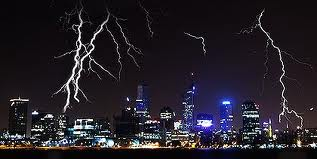
Light Watch 41: Lightning over Perth
LED in the cold…
Perth, 25th February 2011
I am learning more and more about LED’s every day. First I shared with you my experience in regards to dimming, now I need to share with you about temperature and how it affects LED’s. In the old days of fluorescent lighting (well technically it is still applicable) the optimal operating temperatures for fluorescent lighting is so called room temperature, around 25 degrees Celsius. With LED’s this is apparently different.
The main challenge for high brightness LED’s has been and is as far as I know the cooling. When we apply strip lighting we have to make sure the LED’s have a “heat sink” as backing allowing the generated heat to easily dissipate. So it is actually not surprising to learn that LED’s specifically the high brightness types perform better in lower temperatures. It was highlighted to me when we were doing the lighting calculations for a warehousing project with chillers and coolers.
While designing generally against some specific maintenance factors to get maintained values over time, designing an LED installation in this “cool” environment actually increases (according to the manufacturer) the LED’s performance with 10 to 20%, which is quite significant. It is likely also positively influencing the life span of the LED…interesting!
LED technology is moving so fast that we are actually playing catch up all the time. By the time we have completed the design some new factors have come to light. The point is that the LED’s have not been around long enough to really be aware of all its characteristics. We basically discover as we go… 🙂
The last few days (and weeks) have been very hot in Perth. It seems we are on our way to break some summer heat records. La Nina brings flooding and cyclones in the eats but lots of dry hot weather over here! In Light Watch today the beautiful sunsets we get at times. Right now we look forward to the coolness of the nights!
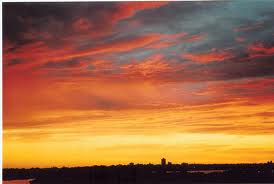
Light Watch 40: Sunset in Perth, Western Australia
LED dimming
Perth, 24th February 2011
One of the latest issues we are now facing as lighting designers is the compatibility of LED lamps for dimming. Though many lamp manufacturers claim their lamps are dimmable it seems that actual dimming capability varies from manufacturer to manufacturer. We are facing this issue now as we are retro fitting some incandescent lamps with their LED equivalent but find out that flickering occurs in the lower dimming ranges. It seems that the big LED lamp manufacturers are aware of this but obviously not very expressive in highlighting this issue to us as designers. We are finding out the “hard” way, specifically when it comes to professional dimming systems.
One of the reasons seems to be that the dimming technology of these systems is still based on good old halogen lighting. Meanwhile back in the factory the manufacturers research teams are frantically trying to catch up with the ever evolving LED technology to find compatible dimming technology!
We found that one of the issues is loading. Dimming a simple 2 or 3 Watt LED causes the lamp to flicker when dimmed low, but as soon as there are a few dimmed together and the combined loading rises to 20 Watt or so the problem disappears…interesting, right? But then again during tests we found a 12W LED E27 retrofit turned out not to be dimmable with the selected dimming system but its “older” 8W brother was dimmable without problem?
My message today is: ”check out your dimming compatibility!” Most lamp manufacturers are aware of the issues surrounding dimming of their LED’s and some of them have even a list of the dimming systems that they have tested their lights with. In my case now I have to make a judgement call. Changing the LED lamp manufacturer brand may not resolve my problem and vice versa selecting another dimming system neither. So based on the actual test results I will delete one dimming circuit where I feel the high performance is more important than the ability to dim and in the other case I will have the dimming programmed to cut off to zero when flickering level is reached as I am satisfied that the lowest (non-flickering level) is acceptable. No one will know… 🙂
In Light Watch today the twilight time of the day, the time at dusk when the sun has disappeared (or dimmed down so you want) and night time takes over or vice versa at dawn when daylight emerges…
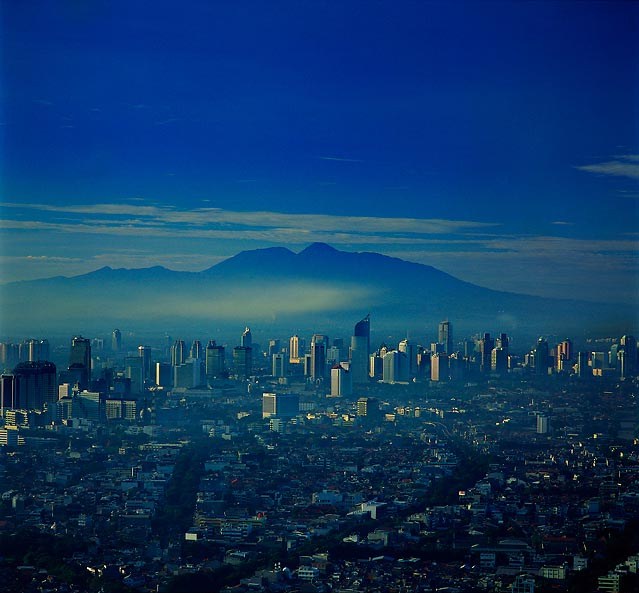
Light Watch 39: Twilight in Jakarta, Indonesia
Left or right handed
Perth, 23rd February 2011
Many tasks and sports have to deal with whether you are right handed or left handed. Writing is probably one of the most obvious ones. In sports we have left and right handed golfers and tennis players. But what about lighting?
One of the main issues for lighting is a desk for working tasks. If you are right handed you pretty much need the light to come from the left and vice versa to avoid your hand casting a shadow on your writing. In case of a desk top light this means positioning the light on one side but making sure the light has a reach to overcome the obstruction of your hand.
I had an interesting session today in confirming bedside lighting controls for one of our hotel projects. We are trying to configure one set of controls to fit all type of guestrooms. We confirmed the number of switches required for each bedside but were then confronted with two challenges. Originally we only figured out one which is the difference between one large (King) bed arrangement and a double bed (Twin) room arrangement. In the first case the controls are on the outer side, in the second case they are located in between the beds.
However we then realised that rooms are mirrored alternately and hence the “left” hand switches have to be configured for the “right” hand in the mirrored room situation. Which made me think of left and right hand issues….
In Light Watch today I list one of our on-going projects in Australia, the lighting of a golf driving range in Kalgoorlie, Western Australia. We are working on a novel way (developed by and with Abacus Lighting) with lights mounted in the ground rather then the conventional pole mounted floodlights. The tee-off area obviously need to be designed to suit both left and right hand golfers…
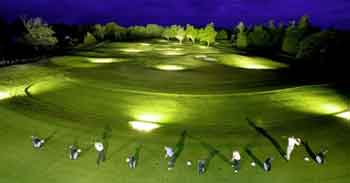
Light Watch 38: Proposed driving range lighting at Kalgoorlie Golf Course
 The long awaited book compilation of Martin's first year of blogging is available. Order now.
 Feedspot Top 100 Lighting Blogs