
Travel alert
Singapore 19th October 2010
I was supposed to leave for Hainan tomorrow but super typhoon Megi is causing havoc in the area, with already huge damages in the Philippines, so I have decided to postpone my trip. No need to play the hero. I may be able to reach Sanya, but with landfall in Hainan expected late tomorrow the typhoon may make work impossible and as a result we may be stuck for some days as well. The client is understandably not happy as we had already postponed the trip for other reasons, but nowadays I don’t feel putting myself at risk unnecessarily. My design manager travelling with me is a young mother of a 1 year old adorable boy, why put her life at risk as well? My travel agent advised us strongly not to travel unless really urgent.
What is wisdom? Nature is hard to predict and the path of the cyclone my change direction as they often do and never hit Hainan, who knows? Time will tell. If it does hit Hainan and create extensive havoc, I will feel justified for my decision to cancel. If it in the end does not hit Hainan and does not cause any measurable impact the client will feel justified in insisting I come. In the end we make our own judgment call on these situations, and to me today was an easy decision to make.
Nowadays there are also other travel alerts related to terrorism. I have cancelled a previous trip to India late last year when the government issued a travel alert for India as there was an impending risk for terror attacks. Again the client was not happy but I made the call and even though nothing happened I believe it was the right decision. I note that a year earlier I was just a few days out of being in one of the Mumbai hotels when it got attacked by terrorists…the thought was rather chilling!
So nowadays we have a travel alert clause in our contracts that allows us to cancel trips when travel alerts are issued for travel, whether in regards to natural causes or potential terrorist threats. I think it is a sensible thing to do and it makes the client aware from the beginning that you may not come out when such travel alerts are issued.
Social networking
Singapore 18th October 2010
As part of our business we are invited regularly to a sponsor or supplier night. Often the sponsor and the lighting supplier are the same and the “get together” is organized in conjunction with an event. Tonight the lighting fraternity attended a Philips sponsored night in conjunction with the I-Light festival at Marina Bay. Philips is one of the main sponsors. It is one of those nights were you meet your friends, colleagues and competitors in the lighting business. Our world is a small world and competition amongst us mostly friendly so it is nice to catch up and share experiences about our work. It is also a good place to catch up on the gossip, but I will keep that part to myself… 🙂
Social networking plays an important part in our business life. We meet new people, make new contacts and through word of mouth we get new business. Sometimes we meet by coincidence. Two weeks ago I met a former lighting supplier I had not seen in a decade, but the coincidence is that I met him at the chiropractor who is treating my back. He was getting a treatment there too. We brought back some old memories, exchanged contacts and low and behold a week later he contacted me with a lead for a new project which I am negotiating now….Tonight again I met some new and interesting people and you never know what will come out of it. Time will tell!
What always fascinates me is people’s background and how they got to where they are in their life. Some had it easy, some had it tough and some had really amazing adventures en route to their current situation. I like to think my path to the present has been pretty amazing with lots of ups and downs spiced with unpredictable adventures along the way. I feel blessed and am very grateful for where I am. It is the people I met along the way and the opportunities they brought along that have shaped my life. Without the mistakes, I would not have learned, without the successes I would not have matured. Social networking is an art at which I don’t feel overly skilled but that has certainly helped me grow, businesswise and personally.
View from the top (2)
Singapore 17th October 2010
Having a “helicopter” view on a lighting installation can be very revealing. Most of the time we see our installations from relatively close distance, often also because of limited viewing distances. Building lighting installations designed for public viewing or as a landmark destination are generally designed in 3 steps, for far away as a recognizable landmark or identity, for closer up when approaching and for street view on arrival. Rarely do we see our installation from the top down. Today I went to the Marina Bay Sands Sky Gardens one of the highest points on the Bay to have a look down at our Whirlpool. It looked great, even better than from the ground. From above the actual whirlpool effect comes out really well.
In a metaphoric way viewing things from a different angle can help getting a better perspective on situations. Sometimes we are so engrossed in our work that we can see the big picture anymore. Because we have been involved from the design stages we know what is right and works as planned and what is not. To a person who sees an installation for the first time they see it without “baggage”. They have no knowledge of how it should look like and hence take the lighting effects as being intended that way. You may argue about whether you like it or not, but generally the public does not see what we see.
It was therefore good to step out of my design cage and mix with the public to get a feeling of the reactions that people have when they see our installation. Certainly when it concerns “art” to me is a totally new ballgame even though you can argue that an architectural lighting installation is (or can be) as creative and arty as an actual artwork. While I am totally comfortable with peoples appreciation of our architectural designs, I am in unfamiliar territory when it comes to art installations like this. But as I mentioned before in art basically everything goes. Some people like it some don’t, that’s life. You can not argue about taste and preferences. But is is nice to have positive feedback and my view from the top today gave me a lot of confidence for the future.
Lighting and obesity
Singapore 16th October 2010
I read with interest an article this week about research that has shown that too much light at night potentially can lead to weight gain! I have collected some extra kilo’s over the last couple of years though I never thought that lighting could be the culprit, but may be it was! Here was I thinking it was just a matter of discipline with food and exercising! The study (carried out by the Ohio State University and published in the National Academy of Sciences journal) was conducted on mice (why do they always seem to use mice??) over a period of 8 weeks and found that mice exposed to light during the night gained 50% more weight then those exposed to a normal day-night life cycle. That is quite a substantial weight gain!
The researchers think that the result maybe a sign that light has an effect on our metabolism. Well I think they are pretty much right there! Their conclusion is that lighting at night made the mice wanting to eat at the wrong times messing up their metabolism. If these results are confirmed for humans it would suggest that late night eating (triggered by late night lighting) would be a cause for obesity. In most developed nations, night life and nightly activities have become a part of life for many and as lighting is an obvious environmental factor related to it. The researchers therefore believe that (late night) lighting may be one of the contributing factors to the fast growing obesity problem around the world.
The couched potato syndrome (sitting behind computers and in front of TV’s all the time) had been cited before as reasons for obesity but more in relation to lack of exercise. In “light” of these new findings it may well be that people who use the computer and watch TV a lot at night are tempted to eat at the wrong times and hence disrupting their metabolism. Which would explain that even those who exercise regularly and watch their food intake, still may gain weight if exposed to light at night.
At least now I have a good excuse! 🙂
The art of selling
Singapore 15th October 2010
We made it! Despite the setbacks and delays we managed to have our artwork working in time for the opening. I must say that the organisers put in a great job to promote the event. One does not always realize what comes into play (and how much money is spent!) to organize such events. In Singapore the government really got inspired by the Smart Light Sydney concept last year and thought it would be a great way to promote the new lifestyle hub that Marina Bay is becoming with the arrival of Marina Bay Sands and the heritage conversion of the Fullerton area.
However having the concept is one thing but organising and promoting it to the general public is something else. How do you sell art? It takes a lot of well planned media advertising campaigns to warm the public up for such events, certainly in countries that is yet building its cultural image. But I have to say that for I-Light Singapore at the Marina Bay it has worked out really well judging by the numbers that turned up tonight for the opening event. So much so that we had to adapt the people count on our detection software that is providing the input for our lighting effects because of the much higher than expected flow of people. But despite the few hitches and no thanks to our late night (early morning efforts) it turned out very well with some great and enthusiastic responses from the public. Being the only artwork in the water it really provides an unique contribution to the festival.
With a great start and positive feedback from the public I expect word of mouth to do the selling and the light festival to be a great success. For me who comes from an architectural background it is a new adventure. When you call it art really anything goes (contrary to architectural lighting), It is the way you sell it that makes it work!
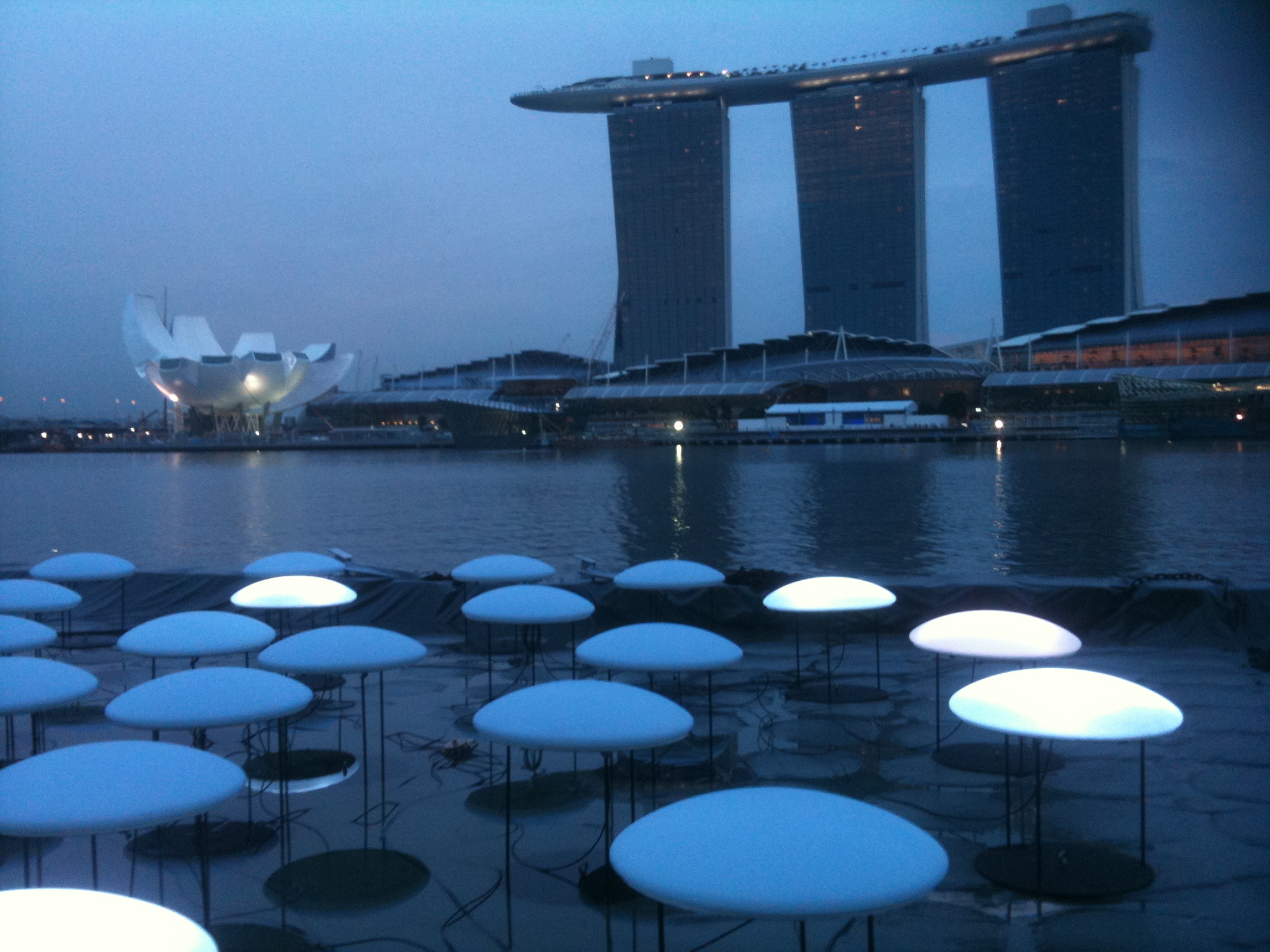
The whirlpool
I Light Singapore 15th October – 7th November 2010
Getting down and dirty
Singapore 14th October 2010
Lighting designers don’t often get their hands dirty. I mean really getting down in the “gutter” to do all the dirty installation work. We have our office work, our travels, our meetings and site visits. Even during site visits we generally still have our “office clothes” on. The actual manual labor of installation is left to the contractor and his work men. Climbing up a scaffolding and actually installing lights is generally not part of the script. If anything we just give directions of what needs to be done. Yes we do get to wear a safety helmet….
But I like the installation part and when it happens I do like to get my hands dirty. It is the part where you really learn to understand what your lighting design means at the other end of the scale! If you have installed lights yourself you will far better understand the implications of your design and light fitting selection!
Today (and yesterday) was such day. Shorts, polo shirt, old runners, tool box….I personally participated in the installation of our artwork and as a write my blog its past 4.30 am as I just came back from a long night. Our artwork is mounted on a floating platform and the installation was a rather wet affair. Wet clothes, soggy runners, sweaty shirt, grease everywhere. We installed the lights during the day and spent the rest of the night testing and programming. As always it does work out as smoothly as you wish. Missing cables, connectors, in our case faulty DMX and lighting control issues, etc. So you have to get down and dirty on the floor, crawl under the lights to figure out what’s wrong.
But once it all comes together and you see it all working as you imagined you have a great feeling of satisfaction even more so because you actually and physically went in there to make sure it worked. You can rely on others to do the work but one is never served as well as by oneself!
The intelligent office
Singapore 13th October 2010
One of the signs of progress is growth and the need to put in place systems that can handle and facilitate the increased demand for communication, filing, administration, etc. We are currently going through such phase and are negotiating with IT companies to upgrade our current system to a network that can be accessed by everyone in the company whether in Singapore or China. We received some proposals (yes, it is not cheap) and need to assess and decide which company to go with. This business is very much about reliability (I don’t know about you but if I can’t get online or my laptop is not working you are sure to catch me in a bad mood!). So in choosing an IT company to provide the services we very much look for reliability and proven track record.
For those who have lived the lighting design profession without personal computers like me, we have come quite a long way. When I started the big main frame computers had just made their entry in our world of design, later followed by the little Hewlett Packard calculators. But still it was requiring huge amounts of paper plots to physically assess the lighting design and we had whole storage rooms full of drawings and documents. Now we are nearing the paperless age and the intelligent office.
A good IT network will do much more than only communications like email, internet, VOIP, etc. It is much about filing project information, file sharing within our own offices and between staff as well as with clients (FTP sites), making it easy to file and share information with quick and easy access. But there are also other functions such as calendar sharing/ meeting schedules and tele-conferencing. More and more we meetings take place virtually.
With all these facilities we also open ourselves up to potential cyber “attacks” so security in the form of firewalls and safety protocols need to be taken into consideration. Last but not least we have the possibility (and duty) to create auto back-ups of all our files and systems, nowadays an absolute must, as without actual paper files a computer crash may mean total loss of information!
Legal and financial
Singapore, 12th October 2010
Designers are generally good at what they are supposed to be good at…finding creative solutions and design concepts for their clients who have often no idea what it means to be a creative soul. It is rare that outstanding designers also are outstanding at the business side of things. I am talking about the legal and financial side of our business. Yet our clients are big multi-national project developers who have a huge financial and legal department to their disposal to make sure their interests are protected. So when big contracts are thrown on our desk we have quite a challenge on our hands. As a small practice we may have a project administrator in our team, but for serious legal and financial issues we need to rely on outside resources, at least we do.
Financial matters are quite straight forward. We are able to keep our books with some accounting software and sent the accounts of to an outside company once a month for the official paperwork. Then at the end of the (financial) year they can easily compile our income and company tax returns for lodging with the authorities. You need however some understanding of financials to be able to read all the figures which do not always make sense to us. As long as it all tallies at the bottom line and you are in the black… 🙂
Legal matters are much more complicated as this can be anything from project contracts to shareholders agreements to employment contracts and resolving disputes. Knowing your legal rights as a director or as an employee should be a given, but how well do we actually know our rights (and duties)? A lot of the legal writing looks like from another planet and by the time you have reach the end of a clause you have absolutely no idea anymore what it is about…you know what I mean? So not only do you need a legal eagle to put such documents together, you subsequently also need one in conflicts to actually tell you what it means! In the process you pay hundreds of dollars per hour. When things go well we have no such worries, it is only when things turn sour that we find out how well we are legally prepared and protected!
The agony of supplies
Singapore 11th October 2010
D-Day is approaching and we still haven’t got our lights! I am talking about the domes with LED lights that we ordered months ago from China for our artwork. The grand opening of the festival is this Friday and we had hoped to be all up and running with only programming left to do. That what seemed the simplest (delivery of off- the-shelf products) turns out to be our biggest nightmare. That what seemed the trickiest (interfacing of the systems and programming of all lighting effects) is more or less done but only dry tested on the computer.
As we speak the lights are yet to leave the airport in China, the latest feedback we got is maybe on the 3am flight. With the press night this Wednesday and the opening this Friday we will be sweating it out to have it all finished in time. We are still not clear what is causing the delay. We knew about the China National Holiday last week so we urged the supplier to make sure it would leave before, but we were obviously not the only ones and probably ended up in a queue. Then there seem to be an issue with certification of the batteries in order to allow them on the plane (don’t ask me why)! That is now taken care off, so fingers crossed for tonight’s flight. But even when they arrive in Singapore (hopefully tomorrow morning) we still have to clear customs this end, no short cuts here.
This is so typical for deliveries in our lighting projects. It happens all the time but generally it is the client/ contractor’s responsibility to coordinate and manage the deliveries with installation works on site. Our main task is to make sure our light fitting specifications are completed within the overall building schedule, leaving enough time for the client to (first negotiate the purchase order and then) order the light fittings and have them delivered to site. It is not for nothing that suppliers quote 8 to 12 weeks for supply as they encounter many variables they do not control. Small orders may be piggy-backed to larger shipments to fit in the back of larger containers (to save costs), but that means dependence on others again. A world apart but crucial to the success of our project, or any project for that matter!
The perils of a rush job
Singapore 10th October 2010
Today is the magic 10-10-10 day. For some a sign of austerity and good luck for others a prediction of impending doom with a major virus attack on your computer waiting to happen. I guess we can decide to believe what we want and act accordingly, everyone has their own beliefs and perceptions… it’s a free world. To me it’s just a day like any other, in this case a weekend where I juggle between doing some pressing project work and having some quality time off with my lovely partner.
This blog is triggered by the reports I read from the Commonwealth Games about the many problems faced throughout the venues and accommodations that were specifically build for the Games. It has been obvious from the many press reports over the last few months preceding the opening that time management has been the main culprit. A too relaxed attitude in the beginning resulting in a rush job towards the end to finish in time. This is certainly not typical for India only. It happens throughout Asia, very few projects are well time managed and as a result many projects that still need to open on “D-day” face hasty rush jobs to meet the deadlines.
One reporter called the Delhi Games the ultimate rush job…the resulting perils reported from Delhi are multiple. Socket outlets that are not working, presumably not even connected, lights not working, toilet flush that keeps going, but more seriously structures that collapse due to the hasty set up. A huge electronic scoreboard costing hundreds of thousands of dollars came down in the Rugby stadium. Another typical aspect of a rush job is that many systems have not been properly programmed and tested. Ticket booths were set up last minute, some after the games started, but the printers did not work as there was no time to test them.
Add to that inexperience of staff and the lack of time to train them with working systems and the chaos can be complete at times. It is just a stark reminder how important good time management is. In our lighting design business it applies too. Budget issues a part, a rush job is only a half job…in any project.
 The long awaited book compilation of Martin's first year of blogging is available. Order now.
 Feedspot Top 100 Lighting Blogs