
Light Talk is taking a break…
During my break I will share some pictures I took of the World Expo 2010 which closed today
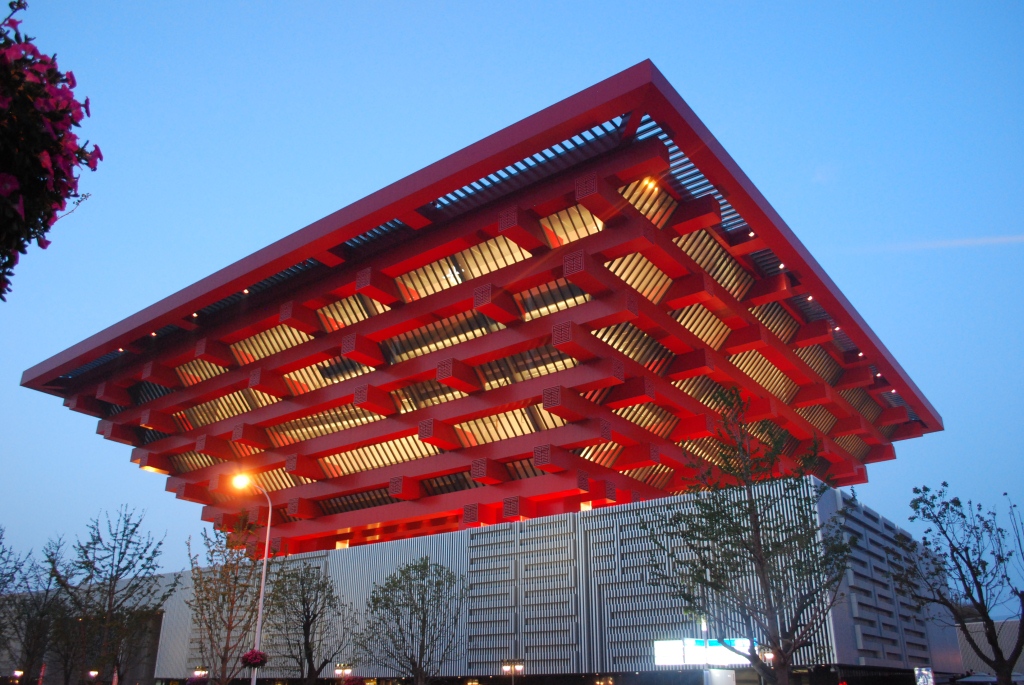
China pavillion
365 days!
Perth 28th October 2010
After 365 days without missing a beat I have finally completed my challenge of one year of daily blogging! When I embarked on this project exactly one year ago I had no idea whether I would manage to keep it up or whether I would be able to come up with the subjects for each blog. But somehow I really got the hang of it, letting me guide by every day happenings either in my own work as a lighting designer or by events in the world that I felt were related to our lighting world. In fact it has become some sort of addiction leaving me feeling incomplete if I haven’t done my blog for the day.
Some of you who have been regular followers over the past year may also have noticed the blog becoming longer and longer! What started with about 200 words per blog gradually grew to now close to 400 words per blog! It has also been a great way to review each day gone by, look back and see what worked or went right and what not in our world of light and lighting! I haven’t read all blogs back yet but over the course of the next couple of months I will start analyzing trends and happenings as reported in my blogs and collate them into some statistics and a presentation that I hope to share with you at the next PLDC in Madrid 2011. Let’s not forget it all started at last year’s PLDC in Berlin!
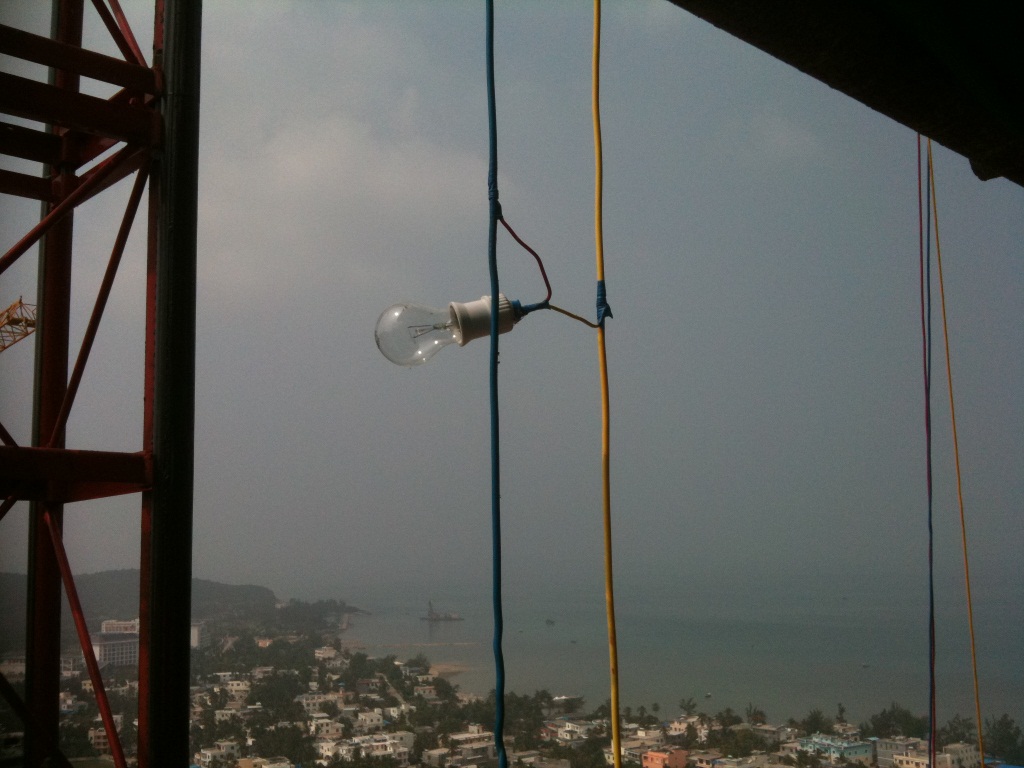
I end this blog with a picture that I feel sort of symbolically represents the past year. The good old incandescent lamp! Photographed on site just a few days ago. The light source that is poised to probably gradually disappear from our lives, a discussion topic that has filled many newspaper and magazine around the world as part of the “green” movement. Will LED lighting ever be able to replace it? The picture also represents simplicity. Despite all the sophistication that we bring into our lighting designs simple still does it. Lighting design is a balance…light and shadow…sophistication and simplicity.
I am taking a short (but well deserved) break, but will be back with “Season 2” in a couple of days. In the new format I intend to introduce pictures as part of my stories…talk soon!
Fee proposals (2)
Perth 27th October 2010
As long as we are submitting fee proposals to our clients we are in business. I don’t know about other practices, but historically we have an average scoring or success rate of over 30%. In other words, for every 10 fee proposals we submit to a client we get appointed for 3. This means that we can roughly anticipate our future income based on the fee proposals we make and hence also my statement that as long as we keep being invited to submit a fee proposal for our services we are in business. Making fee proposals is a vital and recurring part of our work, but it is a happy one. In times of economic stress we feel it immediately as the requests for fee proposals slowly decreases.
I have been preparing fee proposals for years but time and again I find it a challenge to get it “right”. Every project is different, every work condition is different, and every client is different. On top of that the economic climate and market conditions change continuously. Clients also have ever changing demands and expectations. Not to forget that with growing expertise, project experience and track record your reputation grows and you can gradually command higher fees. So in a way we are always pushing the fee boundaries. I have to say that when you have plenty of work that is of course much easier. In fact when you are at maximum capacity you don’t really need more work, but instead of saying no to a client we generally significantly push our fees up, getting them to decline :).
Time based fee proposals are generally the best as you get paid proportionate to your time spent, which means you never really can get wrong. But clients generally do not like this “blank cheque” for unlimited time and therefore understandably wish you to quote as a lump sum so they know what they are up for.
Today I proposed a combination of lump sum and time based fees. Specifically when it comes to site execution, it is not easy to log in a lump sum fee as the building progress is not under our control, contrary to the actual design process which is much easier for us to control. Will see for this project….time will tell!
Out of sight, out of mind
Hainan – Perth 26th October 2010
This saying is very much applicable in our business, probably in any business. It applies at many different levels. I am on my way back after having spent two days “mending ties” with our client in Hainan after our relationship had come under some tension as we had not been able to meet nor deliver to expectations in recent months for a variety of reasons. Add the language (lost in translation) barrier in the mix and you can get an idea of a client feeling left in the cold. Of course from our point of view we have never left him in the cold but at times sheer physical presence and re-assuring words go a long way to give peace of mind. A stressed client easily becomes unreasonable and the ensuing domino effect is that we get frustrated as a result.
One of our big challenges with overseas projects is to keep vigilant when it comes to our relationship (and communications) with the client. We can’t always be on site or meeting the client/ project team, so we need to find ways to keep the communication going (e-mail, phone-calls, tele-conferencing, document issues, etc). So out of sight becomes out of mind and the feeling is that we are not providing the proper support, whether true or not. Unfortunately when we are faced with busy times project wise with many deadlines and clients asking for our attention, some skip below the radar at times. When our team capacity is under pressure we tend to respond to clients who shout hardest! By making extra time available this trip and delivering beyond expectation we have at least restored the client’s faith in us.
Out of sight and out of mind also applies very much when we do our project acquisition. We cannot expect (nor assume) that our clients always will call us first for new projects. Those fresh in their minds usually get the attention, even if you have been doing business with them in the past.
The King of Lighting Tower
Hainan 25th October 2010
A new 330m high landmark tower is going to be built in Guzhen, a township in Zhongshan near Guangzhou, China, which will be called the King of Lighting Tower. I read this in the China Daily on my way to Hainan yesterday. For the un-initiated, Guzhen is also called the lighting capital of China where virtually a whole township is dedicated to lighting alone.
If you have never been there it is hard to appreciate how much is dedicated to lighting, shop after shop, street after street. Anything you need can be found there, most of all your cheap “china-stuff’ comes from there. According to the article there are more than 9000 (!) lighting companies, more than 3000 (!) lighting shops and more than 4000 (!) lighting accessory companies which provides work to well over 70,000 people! It claims further that Guzhen exports more than 60% of the lights to more then 130 countries all over the world. The export is valued at about U$100 Million. I don’t know wether all these figures have been embellished, but having been there I like to believe they are close to the truth. In fact the reality maybe a multiple of that as some transactions may not even be officially recorded (!).
Interestingly Guzhen seems to be re-inventing itself, or so the article claims. The local R&D institutes and companies involved in drafting standards for the lighting industry (that is in a way a bit worrying…) are developing Guzhen as a center of eco-friendly lighting on the back of their enormous energy saving lamps and LED industry. There are apparently more than 500 LED manufacturers in Guzhen, easily the biggest LED manufacturing center globally!
I have no details about the tower other than that it will be shaped as an oil lamp. It will house an observation deck, restaurants, a conference center and most of all a lighting museum. There is no information about who the designers are. Perhaps more information will follow soon. Knowing the Guzhen style, I am very curious to find out more about this “mother of all lighting towers, the King of Lighting!
Light and doping
Hainan 24th October 2010
I am borrowing this title and subject from an article in the latest PLD magazine that I just received. The article talks about the positive influence of lighting on school kids, specifically those starting early (when still dark) and who as a result have not had their daily dose of daylight. While I assume the title was used tongue in cheek, there is something to say about using (day) light as a “performance enhancing drug”.
In today’s top sport and high performance activities doping is rife and there isn’t a Game or World sports event without somebody caught suspected of doping. Cyclists, weight lifters, athlete’s, you name it, some of the biggest names have been caught out on doping. As we speak Alberto Contador, this year’s winner of the Tour de France is being suspected of doping. Even Lance Armstrong can’t escape suspicion. They use blood stimulators and other performance enhancing drugs that provide more stamina, more muscle power, more endurance. But really isn’t light the most natural drug? I would nearly say it is an organic performance enhancer, staying with today’s terminology. All natural no side effects! J
We tend to forget that (natural) lighting is one of the most powerful medicines that exists, but in today’s world we take lighting so much for granted that we forget how much light can make or break our health and with it our physical and mental performance! I blogged in one of my very early blogs about the need for our daily dose of daylight. I am sure that research will find that with dedicated light therapies we can enhance our human performance in every aspect! It is still very much an area of research and an area where we as “ordinary” lighting designers still have to learn a lot. I know airlines are researching the subject to combat jet lag, night shift workers are being studied in relation to light and performance and the subject of school kids and lighting is now a hot topic as well. While doping has a negative connotation, (natural) light is definitely the drug of the future!
Projects in your back garden
Singapore 23rd October 2010
As I am about to embark on my trip to Hainan, now that typhoon Megi has passed through the area, I am wondering about those “far away” projects, certainly those that take you a day of travel to reach. From Shanghai it is a fairly easy connection with regular direct flights and a relatively short (<3hr) duration. However from Singapore the connection for some reason is horrendous with no direct flights and transit times of about 4 hours in Guangzhou or Hong Kong. A flight that would take about 3 hours direct now takes a full day. We have other projects in odd locations in the region that really take a full day to reach. In other words; for a one day meeting you are away 3 days.
It is something we do not immediately realize when we quote for the project as we do not necessarily check out the actual flights available to reach there, but I guess we should. Our fees generally exclude travelling and we do build in fees for attending a number of meetings, which becomes specifically relevant when you have to travel for several days for one meeting. The “positive” side of this situation is generally that the meeting is dedicated to your presence and pretty full on resolving issues pertaining to your design. Your presence is respected and appreciated and there is a committed attitude to resolve as much as possible, knowing that it may be a while before you are back.
But reversely for the projects that are “in your back garden”, the ones that takes you less than 1 hour or so to reach from your office, your presence is somehow less respected. Since you are around the corner there seems to be this belief that they can call you any time without any notice. I am sure many of you can relate to that. Even worse, they make you attend whole day meetings without consideration for your time. I am therefore very wary of projects that are in my back garden. Travelling maybe a time consuming thing but in the end somehow the meetings are much more fruitful and effective and your input much more respected.
Proven concepts
Singapore 22nd October 2010
As lighting designers we want to be creative and find new solutions and ideas for every new project. At least we start out that way and are always in the hope and search to create that unique lighting design or lighting effect that will set the project apart. We do the whole tour of all the possible concepts, develop new ideas in the process only to come crashing down to earth as reality (and budget) dictates that there is not much room for day dreaming.
I am triggered by this subject today as our artwork in Marina Bay is a really nice concept with all the makings of a great project, but technical hitches, budget limitations and some failing equipment (which we are rushing to replace) has dampened our initial joy. Another lesson learned. When I designed the system I thought of using off the shelf product with the idea that they had proven their quality with their track record. However we redefined the usage (on water!) and reprogrammed the lighting effects (from a 1 pixel to a 16 pixel mode). We also added a far more sophisticated control system (Grand MA) as well as a video camera driven people tracking system. Each individual system had a proven track record but the combined system was totally new and never tested before (except the last day before the opening!).
My point for today is that in our business it is not only about creating beautiful lighting effects (whether in a permanent architectural installation or a temporary artwork situation), but also about durability and reliability. What is the point if it only works on opening night, right? Lighting performance is as much about the effects as about the repeatability of the lighting effects, day in day out. Hence the quality of the lighting installation has to extend all the way from the power supply, through cabling, control systems and fixing to the actual light fittings. Only when all the components are 100% do we achieve a reliable quality installation that is there to stay. Proven concepts with high standard components and system compatibility are therefore key and as much as we want to experiment, innovate and create new things, we need to assure ourselves that these criteria are met.
Owning up to mistakes
Singapore 21st October 2010
I challenged myself yesterday to blog about my mistakes so I should own up and share some with you. That is how I learned the trade anyhow. You have to go through mistakes in order to grow and mature as a lighting designer. But they don’t need to be all yours! A keen observer also learns from other peoples mistakes. Part of us is trained to observe the world around us and analyse assess and appreciate the lighting we see. Criticizing is always a tricky thing as we generally don’t know the history, so I principally refrain from criticizing other people’s work. When it comes to ourselves we just hope that the mistakes we make can be easily corrected and have little impact…
There a different categories of mistakes. Here are a few. Some of my early classic ones are related to scale and proportions. I ever specified a decorative ceiling fixture purely based on the catalogue image without checking its dimensions. When I came to site it looked totally out of proportion and had to be replaced. In another situation I drew a 1:100 scale lighting layout in a 1:50 scale drawing…that does not really work! Always check scale and dimensions!
A critical mistake and an easy trap to fall in, is specifying a light fitting without ever having seen its lighting effect. We are always in a rush and purely selecting a light fitting based on catalogue images (and supplier’s sweet talk!) can result in some embarrassing situations. It has happened to me in the past that the installed product was a far cry from expectations. Now I implore my staff to get a sample first and make sure they physically assure themselves they are satisfied with the lighting effect. Once you have installed 200 pieces and it does not perform it’s a bit too late!
Last but not least I made mistakes in specifying the correct quality of light. In a project not even so long ago we had specified in-ground light fixtures and assumed walk over would be enough. We should have realized that cars (and busses) would be driving over them as well. Not surprisingly we received calls not long after installation about cracking light fixtures. If not for the gallant help of the supplier who replaced them foc, we would have been in trouble. The lesson…never assume…
Write ups
Singapore 20th October 2010
As part of our work we often have to provide write-ups. These can be conceptual stories to support our designs, technical write ups in our lighting documents or promotional write ups for publications or other marketing type materials. Not long ago I prepared a write up for a press release in relation to the launch of the I-Light festival here in Singapore. Now I am in the middle of preparing a synopsis for my guest speaking presentation at the Light Forum in Mumbai later next month.
The challenge for this one is that I have not done my presentation yet. I know what I am going to talk about (façade lighting and the challenges of modern lighting technology) but now I have to anticipate what the full content of the presentation is going to be in order to write this executive summary. That is why sometimes the write up is not always in line with the actual thing the write up is about. Knowing myself, the presentation is going to change up till the last minute, so I need to define the write up in such a way that it is general and changes in the presentation will not affect the overall outcome. I have done it before so I am confident I can deliver…
The thing with write ups (certainly in promotional ones or CV’s) is that we have a tendency to beautify the story, make it exciting and use lines that allow multiple interpretations. We tend to focus on the positive parts, brushing over and even ignoring any weak part of the story. When you do a write up of your work you will trumpet your success, right? It is seldom that I read a story about someone describing all the aspects that are wrong in his or her design. It takes quite some strength and self-acceptance to do that.
Thinking about it, I should challenge myself to write about all my mistakes in a next blog! Hmmm I’ll sleep on it…
 The long awaited book compilation of Martin's first year of blogging is available. Order now.
 Feedspot Top 100 Lighting Blogs